About Us | CAPA Programmes | Interact | Publications and Photos | Home
Training | HIV/AIDS | Communications

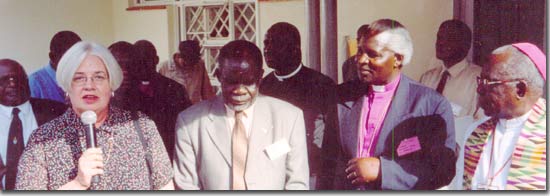
Bishops motivated after undergoing CAPA training

As the 18 bishops packed their bags to leave Mbagala Spiritual Centre in Dar es Salaam two weeks ago, many could not hide the nostalgia they will associate with the centre for a long time to come.

... more


History | Vision Statement | Mission Statement | Core Values

The Council of Anglican Provinces of Africa (CAPA) was established in 1979 in Chilema , Malawi , by Anglican Primates in Africa who saw a need to form a coordinating body that would help in bringing the Anglican Communion in Africa together and articulating issues affecting the Church. The organization was set up with the following aims and objectives:

  • To help the Anglican Churches in Africa develop beneficial relationships between themselves and with the wider Anglican Communion.
  • Provide a forum for the Church in Africa to share experiences, consult and support each other.
  • Confer about common responsibilities on the African continent
  • Establish opportunities for collaboration and joint activities
  • Maintain and develop relationships between the Anglican Church in Africa , Partners, other Denominations, Fellowships, National and Regional Councils.

Today CAPA works with 12 Angican Provinces in Africa and the Diocese of Egypt. These Provinces include Nigeria, West Africa, Sudan, Kenya, Uganda, Tanzania, Congo, Rwanda, Burundi, Central Africa, Southern Africa and Indian Ocean . Its traditional activity has been that of formation of newly consecrated Bishops in issues of leadership and management.

CAPA has since its formation not had a strategic plan to guide its activities and this is the first time that a plan is being put together. Much of what has happened has been mainly through decisions taken by its Governance Organs. Some of these decisions may not have paid attention to the present day realities in Africa and the Anglican Communion Worlwide.

In view of the growing expectation of its key stakeholders who include the 12 various Anglican Provinces in Africa , in terms of its role and leadership, CAPA must continue preparing itself to remain ahead of new challenges and opportunities.

1.2 KEY HIGHLIGHTS OF CAPA HISTORY

Since establishment, CAPA has undergone some important events in its existence among them:

The following are some of the key events in the life of the Organisation:
  • 1981: A programme for training Bishops was started.
  • 1987: Pre-Lambeth meeting for Bishops was organized by CAPA.
  • 1991: A CAPA continental communications workshop was held in Swaziland .
  • 1994: CAPA Secretariat was officially started.
  • 1994: A South-South Encounter Conference was organized by CAPA in Nairobi .
  • 1995: The Bishops Training programme was taken to the Provinces.
  • 2000: CAPA and the World Bank in Nairobi organized a continental poverty alleviation conference.
  • 2001: CAPA organized the Boksburg AIDS Conference held in South Africa .
  • 2001: CAPA acquired its own office space in Kilimani, Nairobi .
  • 2001: A Communications Office was established.
  • 2001: HIV/AIDS Co-ordinating Office was established.
  • 2002: A CAPA continental communications conference was held.
  • 2003: An AIDS Conference for all Provinces is held in Mukono , Uganda .

CAPA's activities have expanded particularly in the last three years in a bid to respond the challenges facing Africa today. This can also be attributed to a change in leadership and CAPA attaining its own identity. There's been a conscious effort to reach out to the Provinces, to have them own CAPA in addition to encouraging them to raise their voice on what they see as the role of CAPA.

At the time when CAPA did not have its own secretariat and was experiencing a leadership crisis, very little was achieved and stakeholders interest was almost lost. But with a renewed leadership and vision, CAPA has been able to attract interest from Provinces and Partners. The organization can be likened to a delayed growth but quickly picking maturity.

^ back to top

VISION STATEMENT

A unified and self-sustaining Anglican Communion in Africa , providing holistic ministry to all and fulfilling God's promise for abundant life.

Key Components of the Vision statement

Unified : CAPA seeks to unify the Anglican Church in Africa even though individual Provinces are uniquely different. It seeks to achieve unity in diversity.

Self-sustaining : We recognize that CAPA needs strategic partnerships and alliances, but efforts will be made to make the Church in Africa able to generate the resources it needs to sustain itself and develop. CAPA will help the Anglican Church in Africa manage and utilize its resources better in order to enhance effectiveness and efficiency.

Anglican Communion in Africa : Though CAPA will essentially focus on whole communities, the Anglican community in Africa is its focus. CAPA will strive to make its presence felt to all Anglicans wherever they are in Africa .

Holistic Ministry : Every effort will be made to help the Anglican Church in Africa meet the physical, social and spiritual needs of all people.

Abundant life : We believe in fullness and enjoyment of life as promised by the Lord Jesus Christ. The Church in Africa shall aim to meet the needs that bring comfort to God's people in Africa .

^ back to top

MISSION STATEMENT

CAPA exists to effectively coordinate and provide a platform for the Anglican Church in Africa to celebrate life, consult and address challenges in the continent in order to fulfill God's promise for abundant life.

Key Components of the Mission Statement

Effectively co-ordinate : CAPA will pursue its mandate of co-ordinating the Church in Africa with the aim of realizing tangible results.

Provide a platform : CAPA will set the stage for Provinces to express their challenges, give their opinions and generate ideas. CAPA will also provide a forum for the Provinces to share their challenges, successes and learn from each other.

Celebrate life : We recognize the importance of thanksgiving and rejoicing in that which we already have. CAPA will create opportunities for the Anglican Church in Africa to thank God together and to commemorate milestones and achievements.

Consult and address : CAPA will encourage Provinces to talk to each other, share information freely and support one another in the pursuit of working jointly to tackle and alleviate problems affecting Anglican members and communities in Africa .

^ back to top

2.3 CORE VALUES

The following core values represent what CAPA stands for and identify the principles that guide our everyday actions. They are practices that help us to achieve our mission and vision.

2.3.1 Commitment and belief in sanctity of life
We believe that life is sacred and that each individual has an inalienable right to life, personal growth and development.

2.3.2 Abundance and celebration of life
We will endeavor to advocate for "life in its fullness" as promised by the Lord Jesus Christ for his people.

2.3.3 Unity in Diversity
We believe in working together with all Christians, partners, staff and stakeholders towards achievement of CAPA's Mission and Vision.

2.3.4 Respect for human dignity
Every human being is special and uniquely created by God no matter the problems they face. We will endeavour to treat all people with dignity and respect.

2.3.5 Co-ordination and provision of a platform
We will bring together the Anglican Church in Africa and provide a forum for it to articulate any issues or concerns.

2.3.5 Professionalism and expertise
The ability to perform duties with expertise and diligence will be our hallmark.

2.3.6 Teamwork
We recognize the interdependence of our various tasks and seek to respect, support and appreciate the contribution and participation of each team player.

2.3.7 Good governance and responsible stewardship
We shall stand for forward planning and involvement in activities that add value to our work, while optimally utilizing available resources.

2.3.8 Transparency and accountability
We shall seek to operate in an honest, open and accountable manner in all our actions.

2.3.9 Participation and sustainability
We recognize that success lies in the full participation of all stakeholders and long-term sustainability of programmes.

^ back to top

Council of Anglican Provinces of Africa
Kilimani, Komo Lane, Off Wood Avenue
P.O.Box 10329 00100 Nairobi
Tel. 020-573700 Fax. 020-570876
email:info@capa-hq.org