History | Vision Statement | Mission Statement | Core Values
The Council of Anglican Provinces of Africa (CAPA) was established in 1979 in Chilema , Malawi , by Anglican Primates in Africa who saw a need to form a coordinating body that would help in bringing the Anglican Communion in Africa together and articulating issues affecting the Church. The organization was set up with the following aims and objectives:
- To help the Anglican Churches in Africa develop beneficial relationships between themselves and with the wider Anglican Communion.
- Provide a forum for the Church in Africa to share experiences, consult and support each other.
- Confer about common responsibilities on the African continent
- Establish opportunities for collaboration and joint activities
- Maintain and develop relationships between the Anglican Church in Africa , Partners, other Denominations, Fellowships, National and Regional Councils.
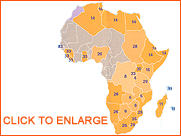
Today CAPA works with 12 Angican Provinces in Africa and the Diocese of Egypt. These Provinces include Nigeria, West Africa, Sudan, Kenya, Uganda, Tanzania, Congo, Rwanda, Burundi, Central Africa, Southern Africa and Indian Ocean . Its traditional activity has been that of formation of newly consecrated Bishops in issues of leadership and management.
CAPA has since its formation not had a strategic plan to guide its activities and this is the first time that a plan is being put together. Much of what has happened has been mainly through decisions taken by its Governance Organs. Some of these decisions may not have paid attention to the present day realities in Africa and the Anglican Communion Worlwide.
In view of the growing expectation of its key stakeholders who include the 12 various Anglican Provinces in Africa , in terms of its role and leadership, CAPA must continue preparing itself to remain ahead of new challenges and opportunities.
1.2 KEY HIGHLIGHTS OF CAPA HISTORY Since establishment, CAPA has undergone some important events in its existence among them:
The following are some of the key events in the life of the Organisation:
- 1981: A programme for training Bishops was started.
- 1987: Pre-Lambeth meeting for Bishops was organized by CAPA.
- 1991: A CAPA continental communications workshop was held in Swaziland .
- 1994: CAPA Secretariat was officially started.
- 1994: A South-South Encounter Conference was organized by CAPA in Nairobi .
- 1995: The Bishops Training programme was taken to the Provinces.
- 2000: CAPA and the World Bank in Nairobi organized a continental poverty alleviation conference.
- 2001: CAPA organized the Boksburg AIDS Conference held in South Africa .
- 2001: CAPA acquired its own office space in Kilimani, Nairobi .
- 2001: A Communications Office was established.
- 2001: HIV/AIDS Co-ordinating Office was established.
- 2002: A CAPA continental communications conference was held.
- 2003: An AIDS Conference for all Provinces is held in Mukono , Uganda .
CAPA's activities have expanded particularly in the last three years in a bid to respond the challenges facing Africa today. This can also be attributed to a change in leadership and CAPA attaining its own identity. There's been a conscious effort to reach out to the Provinces, to have them own CAPA in addition to encouraging them to raise their voice on what they see as the role of CAPA.
At the time when CAPA did not have its own secretariat and was experiencing a leadership crisis, very little was achieved and stakeholders interest was almost lost. But with a renewed leadership and vision, CAPA has been able to attract interest from Provinces and Partners. The organization can be likened to a delayed growth but quickly picking maturity.
^ back to top |

 Council of Anglican Provinces of Africa