Communities Richer in Diversity (CRID) LAUNCH
The Council of Anglican Provinces in Africa (CAPA) and European Union (EU) launch new project in 6 Africa Countries
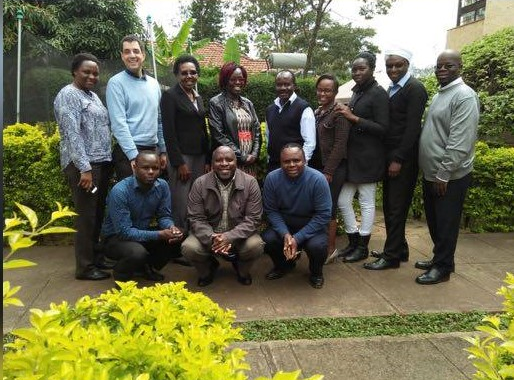
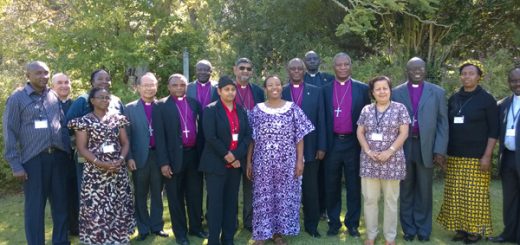
Back-row from left: Elizabeth Gichovi-CAPA; Matthias Brucker-F2A; Hellen Akwii-Wangusa-CAPA; Jacinta Okumu- ACRL:
Canon Kaiso-CAPA, Grace Maina-F2A; Fiona Njoki-ACRL; Sammy Mwangi-CAPA, Tom Okore-ACRL.
Front row: Nicholas Pande-CAPA; Peter Munene-F2A; and Patrick Mbugua-F2A.
The Council of Anglican Provinces in Africa and the European Union have launched a new programme to promote cultural diversity & respect for equal dignity of all people in Burundi, Egypt, Kenya, South Sudan, Tanzania and Uganda through interfaith and intercultural dialogue and cooperation.
The new programme started on April 1st 2018 and is implemented in collaboration with African Council of Religious Leaders – Religions for Peace, Faith to Action Network and the All African Conference of Churches.
The European Union is contributing 1.9 million € and the project partners under CAPA will contribute 200,000 € as co-financing.
Rev Canon Grace Kaiso, General Secretary, Council of Anglican Provinces of Africa says: “Faith leaders can exert powerful influence on leaders and communities for greater pluralism, diversity and peace. The “Communities Richer in Diversity” project leverages this influence to promote cultural diversity and respect for equal dignity of all men and women”.
CAPA understands that youth have been marginalised from political processes, lacking viable economic opportunities. 78 million youth aged between 10-24 in the 6 project countries are experiencing an increasing sense of desperation. They struggle daily to meet their basic needs and find their place in society. This has turned them into easy targets for religious recruiters who lure or coerce boys and girls into radical extremism and violence using a diverse mix of religious and ethnic narratives, financial incentives.
In response, CAPA put together a formidable alliance of all major interfaith networks in Africa to contribute towards positive changes within these different contexts. Put together, this alliance pulls together interfaith organisations that have active presence and constituencies in almost all Africa Countries. CAPA has a strong team of 13 primates, 500 bishops, 20,000 pastors and over 100,000 lay leaders. Serving as umbrella organization of 25 national interreligious councils, the African Council of Religious Leaders - Religions (ACRL) for Peace is the largest and most representative multi-religious platform in Africa. With its 95 faith based members, Faith to Action Network (F2A) is specialized in empowering women and youth through interfaith development approaches. All Africa Conference of Churches has 173 Protestant, Anglican, Orthodox and Indigenous member churches in 40 African countries and is specialized in interfaith mediation and diplomacy. Jointly, they will catalyse faith organizations’ resources, knowledge, commitment and passion to promote pluralism, and build Communities Richer in Diversity (CRID). CRID is specifically designed to enhancing understanding, tolerance and respect for cultural and religious diversity among 14,400 youth at risk of radicalization in the 6 target African countries.
As part of its coordinating and lead role, CAPA convened a 3-day Planning meeting at Bibilica Guest House between 12th and 14th June 2018. The Planning meeting program was designed to deepen team members’ understanding of the project, enable team members to get to know each other, help create a team feeling and review the annual work plan.
The meeting was attended by a total of 13 participants as captured in the picture above.
Built on EU guidelines on rights based approach and gender, the group developed all the essential tools for work-planning, implementing, monitoring, reporting, and measuring performance of the project, and a strategy for raising the 10 % co-funding of 200,000 Euros as a contribution to the CRID Project.
TAM Report Back
In July, CAPA staff were part on the Technical Assistance Missions (TAM) that travelled to provide technical support to the recipients of the CRID sub-grants. The TAMs began with a visit to the Kenya Muslim Youth Association (KYMA).
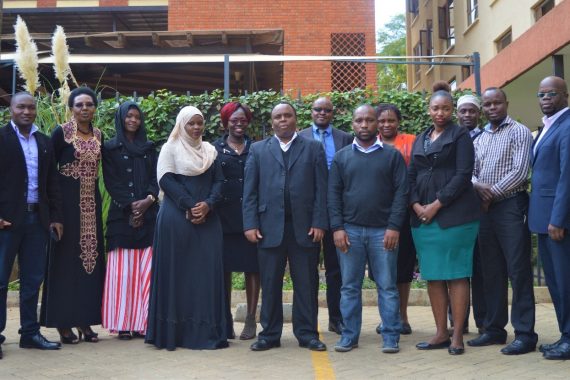 CRID Technical team from all partners with the Kenya
CRID Technical team from all partners with Kenya Muslim Youth Alliance technical team during the technical assistance mission in Kenya.
Rev. Canon Grace Kaiso underscored the meaning and the importance of the technical assistance missions. The missions are central to CRID, as they aimed at, among others, orienting the sub-grantee to the CRID objectives before being considered for funding.
The TAM therefore, worked with the sub-grantees to develop technical documents, enforcing the program principles and establishing relations with the sub-grantees. The missions also aimed at understanding the sub-grantees past achievements and identifying other non-project lessons and best practices which can be used to strengthen their project proposals, as well as generate knowledge which can disseminated to wider audiences.
The TAMs constituted to comprise of one Programme and one Financial manager. Hellen Akwii of CAPA and Elizabeth Gichovi were selected to be part of the technical team to Zanzibar, while Nicholas was joined by Cecily Magati as the TAM to Egypt.
EGYPT’S DEBRIEF
The Anglican Diocese of Egypt is one of the potential sub-grantees. Its constituency covers North Africa and the Horn of Africa. Majority of Egypt’s Christians are Coptics while the Anglicans are a minority. However, the Diocese is very active and has entered into an agreement with the Muslim leaders on inter-faith cooperation. The diocese also works closely with the al-Ahzar University which is well known in the Middle East for training Muslim scholars. Majority of the population in Egypt are Muslims and the population generally identifies with religion.
The Anglican diocese and its partners have implemented various projects in the past. These include ‘Together for Egypt’ and ‘Together we Develop Egypt’. The former started in 2013 and brought together 30 imams and 30 priests to develop relationships and to participate in community development work. The latter sought to advance the achievements of the former by involving another generation. The project involved one Imam and one Priest each leading ten youth, five Christians and five Muslims, in performing service projects that meet the needs of the local community. The diocese has expanded ‘Together we Develop Egypt Project’ which is now in phase two. Key issues from these projects, which are relevant to CRID, are the use of art, paintings, joint public appearances by priests and sheikhs, and inter-faith cooperation.
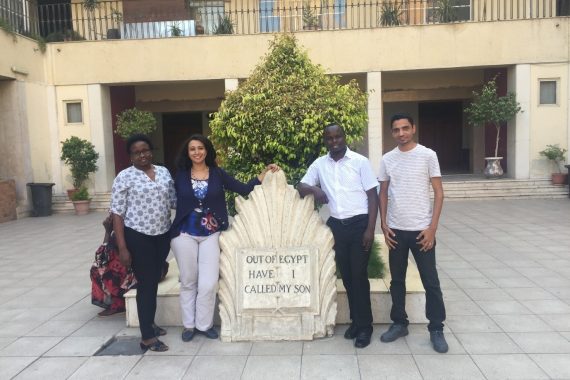
CRID technical staff from CAPA & F2A with staff of Episcopal Diocese of Egypt during the technical assistance mission to Egypt.
The Diocese is currently working on a project named A Journey towards Peaceful Coexistence. Its main aim is to promote coexistence and self-development in Cairo - Zamalek, Ezbet el Nakhal, El Salam City, and Old Cairo Districts through interfaith dialogues and joint activities, including artistic projects. The project will build bridges by drawing from teachings of faith on justice, compassion, patience and respect.
ZANZBAR DEBRIEF
The Context: Anglican Diocese of Zanzibar (ADZ) has its headquarters at the Anglican cathedral which is now a UNESCO heritage site because it is built on the old slave market. The team started with a protocol visit to the Bishop. The Anglican Church is the olderst Christian church in Zanzibar. It has hosted other Christian denominations. The Moravian Church activities are currently being held in spaces offered to it by the Anglican Diocese.
The Diocese has long history spanning over 140 years. Muslims are the majority in Zanzibar and religious issues are very important to the people of Zanzibar. Islam and Arabic are compulsory and examinable in Zanzibar schools. There is one (1) Christian representative in the government of Zanzibar. Because of religious sensitivity, neither Christians nor Muslims are allowed to proselytise or hold open air evangelisation meetings.
Zanzibar has experienced election related violence in every election year since 1995. To address these concerns, the Diocese is working with nine (9) other partners and offers a meeting room to the consortium. The diocese has staff who are qualified and knowledgeable on Islam and Christian issues.
Past activities and achievements: The Diocese has used religious holidays to broadcast messages they consider to be false teaching on radio and through CDs. It has implemented joint projects, and involved Muslim partners in education projects. For example, the diocese has a school which started in 1988 and has 99% Muslim pupils because it has a good reputation for quality education. The Diocese is currently working in partnership with 9 Muslim organisations on a project called “Preventing Violent Extremism and Radicalisation in Zanzibar”. Some of the partners of the Diocese are the Zanzibar Youth Forum (ZYF).
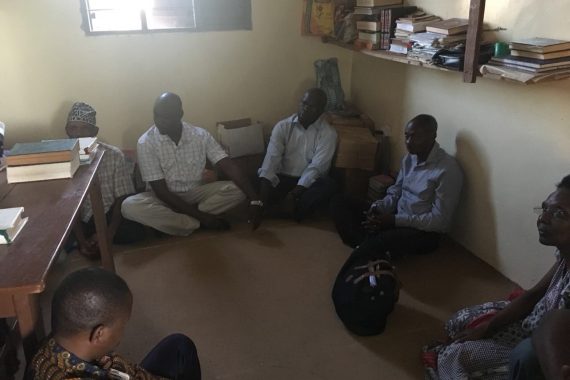
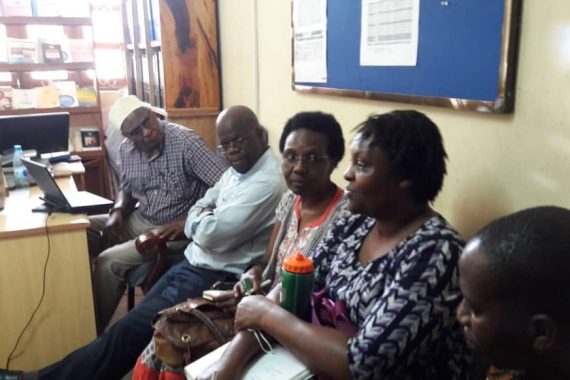 Meeting at the Zanzibar Youth Forum Offices
The Forum works on violent extremism at three levels: micro, meso and macro levels. Micro is the individual level. Here, the Forum respond to issues affecting children who are under pressure to be abreast with technological trends. Meso refers to the family level because most families have left control of their children to schools and the society. Macro level is at the national level. The Forum responds to lack of policy by the government of Zanzibar on prevention of violent extremism. In Zanzibar, political space is limited; this limitation inhibits any form of direct advocacy on prevention of violent extremism. Therefore, projects conceal the work under peacebuilding and security projects. ZYF has identified one of the causes of violent extremism as closed political space which forces the youth to run away to Mombasa and Somalia to join al-Shabaab. Indeed, two of the September 11, 2001 attackers were traced to Zanzibar. Other causes are poverty and unemployment and lack of commitment by the government of Zanzibar. ZYF responses include sensitisation and awareness building and collection of data and statistics. Indeed, the organisation requested the mission team to train them on how they can improve their governance structures.
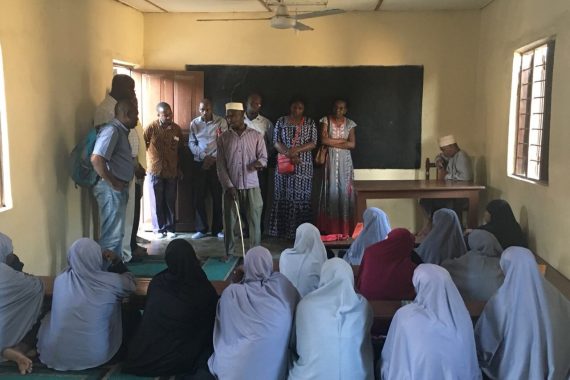
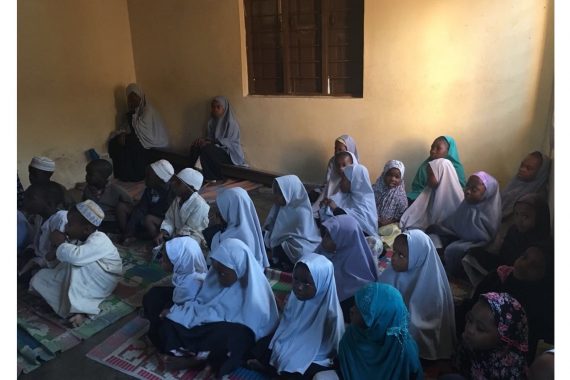
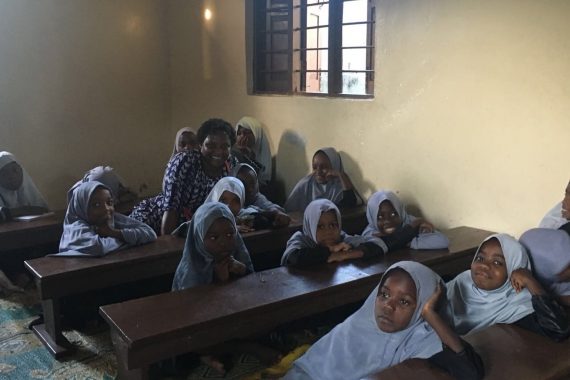 Visiting the JUMAZA Madrasa
Another partner of the Anglican Diocese of Zanzibar in the project is the Woman-led Centre for Youth Dialogue (CYD) which works on reshaping narratives, economic empowering of the youth, counselling and dialogue for solutions. CYD work on all youths and on a very wide scope. A third partner is the JUMAZA which has constituted the Madrassas that use madrassa schools to penetrate the sphere of Islam.
The other member of the consortium is Labyca Foundation which is based in the north region of Zanzibar. The Foundation addresses push and pull factors of violent extremism, especially during elections. It has established a school for training youth in skills needed for jobs in the area like the tourist industry. Labyca promotes girls’ education and was able to see the first female of their community graduate in 2013.