CWWM Consultation 8-10 May 2019
COMMUNIQUE
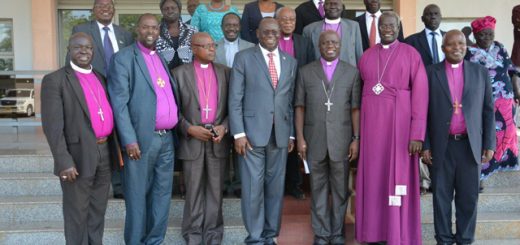
On May 8-10, 2019, a regional workshop was convened by the Council of Anglican Provinces of Africa (CAPA), at Desmond Tutu Centre in All Africa Conference of Churches (AACC) Nairobi, Kenya, to deliberate, as a continuation to the May 2017 meeting held in Nairobi, on migration and human trafficking with a view to define a coordinated response and launch Churches Witnessing With Migrants-Africa (CWWM-A). CWWM-A is an affiliate of CWWM global: it is a regional platformof a tripartite network of grassroots migrants, migrant-serving institutions and faith communities and individuals and partners working for the dignity, hospitality, and companionship of all migrants, refugees and Internally Displaced Persons (IDPs).
The 45 participants from Francophone, Lusophone, Arab phone and Anglophone Africa, comprised 19 men and 16 women and 9 vibrant and well-resourced youth. It also drew survivors of trafficking and migration and partners organisations namely CWWM global from USA and Philippines, the State Department of the Episcopal Church of USA, The Anglican Church of Canada, Act Alliance as well as the African Union (AU). The organisations represented are actively engaged in research and mapping migration routes; rescuing, counselling, reskilling, resettling and reintegrating migrants into society and this undertaking policy analysis and advocacy on related legislation.
On social media, we surpassed our expectation of 2.5 million and added close to 300 new unique followers for CAPA online. We registered a total number of 493 Tweets with an Economic value of $ 6,165.47. The Potential impact was 5,228,975; potential reach 111,377; contributors 42; Tweets/contributors 11.74; Followers/contributors 2.651.83; Original tweets 60.
Our vision is a world where all migrants feel safe, are treated with dignity, and are empowered to realize their full God-given potential. We are structured to work as a regional platform based in CAPA that will coordinate and work in partnership with 4 other sub-regional platforms (can we name them?) and governments through the AU. We set up to build on existing strengths and expertise in our members and global partnerships to support our work and response to migrants, refugees, IDPs as our primary stakeholders.
According to the African Union (AU) Migration Policy Framework for Africa and Plan of Action (2018 – 2030), migration is both voluntary and forced. The drivers, trends and patterns of voluntary migration within and outside national borders are the growing disparity in development between countries and regions, poor socio-economic conditions, low wages, high levels of unemployment, poverty and lack of opportunities, lack of good governance perceived opportunities for a better life, higher incomes, greater security, the pressure to join relatives, families and friends, better quality of education and health care at the destination countries influence decisions to migrate.
The AU categorises migration into: labour migration; mainly intra-regional; refugee flows: inter and intra-regional; irregular or cross-border migration (of specific ethnic groups and pastoral peoples) in West and East Africa, and IDPs: mainly due to environmental/climate factors & civil strife. More than 30 million Africans (about 3% of the continent’s population) are living outside their countries of origin, and evidence suggests that this figure is growing. Most international migration today is related to seeking employment. More than 90% of all international migrants are workers and their families. The number of international migrants by major region of origin as a share of total population shows that Africa in 1990 was at 3.2%, in 2010 had dropped to 2.7% and in 2017 slightly rose to 2.9% as compared to for example Europe that was at 6.6% in 1990, 7.5% in 2010 and 8.2% in 2017, while Asia was at 1.8% in 1990, 2.1% in 2010 and 2.3% in 2017.
The Profile of migrants with the exception of Southern Africa, has the median age of less that 30 years; an indication that the majority of migrants in Africa are youths. There has been an increase in the feminization of migration on the continent. In general, the percentage of female migrants is between 40- 50%.The reasons for the increase in female migration include: moving independently to seek for economic opportunities (trade and employment), education, family re-unification and marriage.
Irregular migration in Africa is increasingly characterized by smuggling and trafficking in human beings. The majority of the trafficked/smuggled are youths, including young women and children. They are being trafficked by often officially registered agencies and sophisticated organized criminal groups. Organ extraction is another lucrative and growing trade associated with human trafficking.
The nexus between Human Trafficking (HT) and terrorismis a multi-million-dollar industry, and there are studies to show that there is a nexus between human trafficking and terrorism. Some terrorist groups (IS/Al Shabaab/Boko Haraam) are involved in Human Trafficking as a means to finance their operations and recruit terrorists. IDPsalsoprovide fertile ground for traffickers/smugglers to fish for “clients”. This is because there are low levels of awareness of Human Trafficking among refugees/IDPs.
Collectively therefore, we have strategic themes and pillars as well as sub-regional, regional and global partners priorities to include, but not limited to, operating regional and sub-regional structures and systems; defining processes to champion membership growth, and effective decision-making. Setting up a media department at the CWWM-A secretariat to champion research in partnership with member organisations and universities and identify advocacy issues and outcomes. We agreed to activate effective communication channels including digital, popularizing our platforms and strengthen partnerships, identify information sources and audiences and generate and coordinate relevant content for sharing including information about the realities of forced migration, trafficking, supply chains, movements of trafficked and forced migration out of Africa to Europe, Arab states and North America. We intend to provide migrants with well tabulated and analysed information on migration and trafficking before departure, along the migration routes and at destination, and to conduct hospitality and migrant-led service-provider mapping, monitor and report partner program performance and foster strategic global partnerships for comprehensive responses to migration and human trafficking as an evil.
We are aware of the historical baggage and challenges related to current geo-political context and continued effects of neo-liberal economic trends, trade wars, and IMF’s lower projection for global economic growth in the beginning of 2019 at 3.5 %, as compared to their projection in October 2018 at 3.7 %;
We are mindful of the impact of the Organisation for Economic Co-operation and Development (OECD) recent announcement last March 2019 - global gross domestic product (GDP) growth for 2019 will be 3.3%, down from 3.6% in 2018. 61% of the world’s workforce in 2016 were in the informal employment, and the import of the bailouts that have always been about saving the richest and right-wing parties in the North;
We are cognizant of the lack of decent work in general, for migrants in particular, and also for the worst human rights abuses in 10 of the worst countries for workers due to poor working conditions from labour flexibilization and that 92 out of 142 countries exclude groups of workers from labour law and less than 87% of countries deny some or all workers their right to strike. 81% of countries deny some or all workers collective bargaining and 54 countries deny or constrain free speech and freedom of assembly, and
We have analysed the implicationof therising right-wing nationalism in the world manifest in some countries in form of continued use of fascist demagogy; Christian fundamentalism, Islamophobia, racism, misogyny, xenophobia to mobilize the “alt-right” versus militant mass movements.
Our call to action is premised on theological and contextual analysis strengthened through strategic regional and global partnerships framed around a grounded appreciation of migrant needs for dignity, hospitality and companionship.
·
We are resolved to ensure nothing is done for migrants without migrants and shall champion migrant-led solutions, be accountable, build our skills and expertise to enable us reach-out and meet member’s needs;
·
We seek to learn from each other and our partners and to mobilise resources to support evidence-based advocacy and decision-making on migration and human trafficking including supporting migrant needs;
·
We build on our existing synergy to ensure migrants are treated with dignity, met with hospitality and have companionship through their journey and,
·
Draw strength from the assurance that,
“…if you have faith the size of a mustard seed, you will say to this mountain, “Move from here to there”, and it will move; and nothing will be impossible for you.’